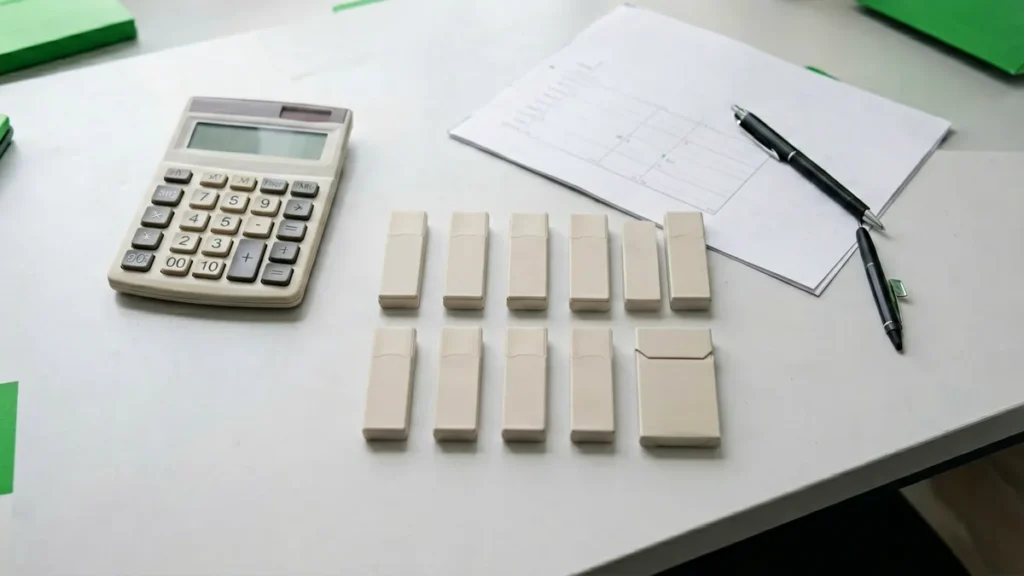
Direct answer: divide a live carton price by the number of packs stated in that exact sale unit. For a Texvilo listing described as 1 carton (10 packs), divide the dated carton amount by 10. The result is a calculated per-pack reference for comparing records; it is not a claim that single packs are sold separately.
This factual guide is for Australian adults aged 18 and over. It explains catalogue arithmetic only and does not encourage tobacco use or make health, quality, availability or delivery claims.
Start with the complete catalogue record
A calculation is useful only when the source fields belong to one product record. Before dividing anything, record:
- the complete product name;
- the SKU;
- the displayed AUD carton price;
- the stated sale unit; and
- the date the live page was checked.
Open the live Texvilo shop rather than relying on an old screenshot or search snippet. If the sale unit is unclear, use the related guide on how to check the sale unit before comparing a carton price.
Worked example from a live 10-pack carton listing
On 3 August 2026 in Sydney, the live record for ESSE Lights Super Slim – 1 Carton (10 Packs) showed SKU SS-303, a current price of A$184.00 and an in-stock label. The stock label did not state a quantity.
| Step | Recorded or calculated value |
|---|---|
| Exact sale unit | 1 carton (10 packs) |
| Observed carton price | A$184.00 on 3 August 2026 |
| Calculation | A$184.00 ÷ 10 packs |
| Per-pack reference | A$18.40 |
The A$18.40 figure is derived from the dated carton record. It is not a separately displayed Texvilo price, a permanent amount or evidence that one pack can be purchased on its own.
Common questions this method answers
People searching for a carton price per pack, asking how many packs are inside a cigarette carton, or comparing the cost of a carton with a single pack can use the same two-step method. Take the dated carton price shown in the exact sale unit, divide by the stated pack count, and label the result as a calculated reference rather than a separately displayed price.
- Carton price per pack: divide the listed AUD carton amount by the pack count stated in that same record.
- How many packs are in a carton: read the sale-unit field, for example “1 carton (10 packs)”, and use only that number as the denominator.
- Cost per pack within a carton: the divided result is a worksheet reference for comparison; it does not mean one pack is sold on its own.
To compare live records by brand and SKU, browse the cigarette carton brand catalogue.
Keep observed and calculated values separate
Label the source carton amount as observed and the divided figure as calculated. This prevents a worksheet result from being copied later as though it were a live product price.
- Verify identity. Match the full name and SKU.
- Verify the denominator. Use 10 only when the exact listing states 10 packs.
- Record the live AUD amount. Keep its date beside it.
- Divide once. Carton price ÷ stated pack count = per-pack reference.
- Label the result. Mark it as calculated, not displayed.
When not to calculate
Stop when the product identity, currency, pack count or observation date is missing. Do not combine a price from one SKU with the sale-unit wording from another. Do not use a regular comparison price in place of the current displayed amount unless the purpose of the worksheet is explicitly to calculate a reference from that separate field.
Price and stock can change after the observation date, and a product-page calculation does not determine the final cart or checkout total. Reopen the canonical listing before acting and use the AUD Price Checks guide collection for related catalogue-reading methods.